Microneedling
Microneedling uses the SkinPen Precision Elite to make thousands of tiny pinpricks; as the skin repairs them over the following months, rough texture, acne scarring and early fine lines can soften.
Request a consultationAt a glance
Onset
4–6 weeks
New collagen takes time to form, so the first visible change usually arrives four to six weeks after a session, and a course's result goes on maturing well beyond its last session.
Longevity
6–12 months
Maintenance sessions are often booked every six to twelve months to keep the result going, and the improvement itself can last longer.
Downtime
1–3 days
Pink, much like a day in the sun, usually for a day or two and settled within three; a little dryness may follow.
Discomfort
2–3/10
Scored with the skin numbed: the cream is given time to work before the pen starts, so the needling registers as a light prickle for most people.
Procedure time
75 min
Numbing included: the cream takes the first part of the appointment, and the pen is in use for about 30 to 45 minutes.

Texture and acne scarring, treated through the skin's own repair
People usually come to microneedling having noticed something in the surface of their skin: a rough or uneven texture, often with pores that look larger than they did, marks left by acne years ago, or fine lines beginning to settle. Texture, acne scarring and early fine lines are the changes we offer it for, because it works through the skin's own repair, nothing is injected, and for many people it makes a good first treatment. Where brown marks, redness, loosening or lost volume are part of the picture too, your plan can pair the needling with a treatment suited to each.
i
Fine pinpricks, and the repair that follows
i
Fine pinpricks, and the repair that follows
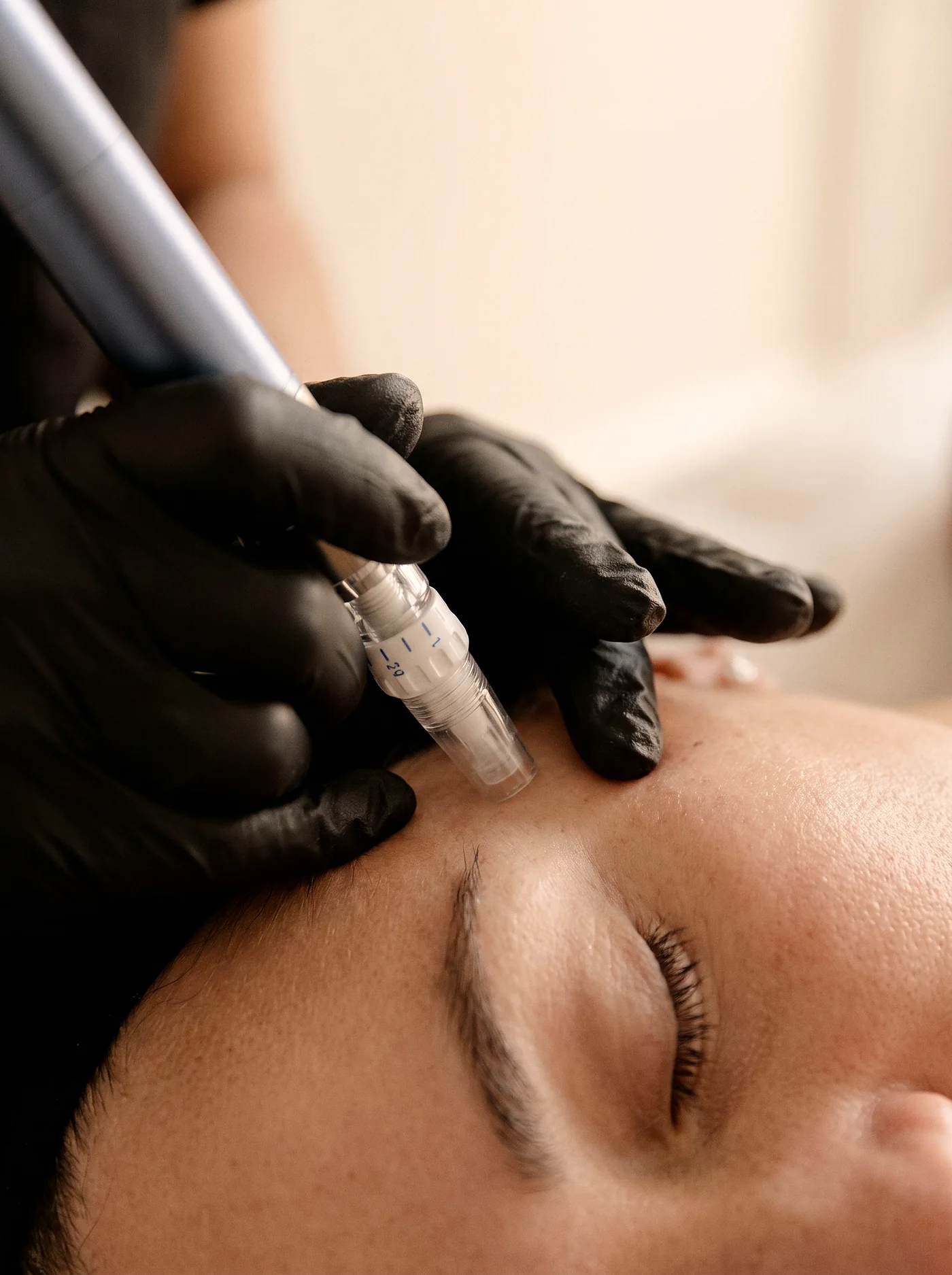
The SkinPen Precision Elite is a handheld pen fitted with a sterile cartridge of 14 very fine needles. As it glides over the skin, the needles move rapidly in and out, leaving a close, even pattern of pinpricks.
Your skin reads each pinprick as something to mend and sets about repairing it. In studies of treated skin, that repair included new collagen and elastin, the fibres that give skin its strength and elasticity. It takes months, which is why microneedling is usually planned as a course, with its result judged some months after the last session rather than the week after the first.
ii
What kind of scarring, what kind of roughness
ii
What kind of scarring, what kind of roughness
Your practitioner studies your skin at close range and asks what bothers you most. With acne scars, the shape matters: broad scars, whether rolling or flat-bottomed (boxcar), usually respond best, and knowing the shape of yours lets the course be planned around it. With roughness, the question is how much is texture and how much is uneven colour, which LaseMD Ultra can treat within the same plan. Lines that deepen with expression come from the muscles beneath, and anti-wrinkle injections can soften those alongside. Your health, medicines and skincare come into it too, as does the way your skin heals after a spot or a graze, because the answers shape the depth, the timing and the aftercare your skin is given.
iii
A plan set by area, and around your diary
iii
A plan set by area, and around your diary
The needle depth is set area by area: shallow where skin lies thin over bone, as on the forehead and nose, and deeper over acne scarring on the cheeks, within the limits the SkinPen's instructions give for each. The fine skin under the eyes is cared for with other treatments. You can book a single session, perhaps to find out how your skin reacts, or a course of three, with a minimum of four weeks between sessions. Most people look a little flushed for a day or two after each one, so it's worth booking a few days clear of anything important.
iv
"The thought of needles going into my face puts me off."
iv
"The thought of needles going into my face puts me off."
Plenty of people feel that way beforehand, and your appointment is planned with it in mind. A numbing cream is applied well ahead of the pen and given time to take effect, which is why the appointment runs to 75 minutes when the needling takes well under an hour. With your skin numbed, what most people notice is a light prickle and the pen's steady hum as it moves across each area.
Ask for a pause whenever you like, for as long as you like. Numbing doesn't dilute the treatment either: the needles still reach the depth set for each area of your skin.
What happens,
in order
Step 1 of 6 · Your consultation, before any session
Scars and texture mapped, area by area
At your consultation, the scarring or texture you've noticed is examined up close, and your health, medicines and skincare are talked through. Together you agree where the pen will work, the depth for each area, and one session or a course of three, with or without exosomes; the fee is set out before you commit.
Why add exosomes
to a SkinPen session
Any session, a single one or each of a course, can be booked with exosomes. The needling stays exactly as it is; the serum is the finishing step, smoothed over your skin once the pen has done its work.
i
What the serum is
Exosomes are tiny particles that cells release, each wrapped in a thin membrane. The serum used here contains exosomes from plants, sold as a cosmetic and applied to the surface of your skin, never injected. Exosomes taken from human cells are banned from cosmetics in the UK, and none are used at ART Clinic.
ii
Made for skin fresh from the pen
Straight after needling, your skin feels warm and a little tight, and that is the moment the serum goes on. It is designed to soothe and hydrate freshly needled skin, so your session finishes on a gentle step that looks after your skin while it settles, before you head back to your day.
iii
Added in minutes, to any session
Adding the serum asks nothing extra of your day: the same booking, the same numbing and the same needling, with the serum smoothed on in the final minutes. It can join a single session or every session of a course, and you choose at your consultation, with the fee for each option set out in front of you.
Needling, laser, peel or injectable:
how they differ
Four other treatments at ART Clinic work on the skin itself, each aimed at a different change. Here is what each does that needling doesn't, and where the two can share a plan.
LaseMD Ultra, where colour is part of it
Pigment is usually the dividing line. LaseMD Ultra is a laser that treats sun spots, uneven tone and dullness in the same course as rough texture, while microneedling works on texture and scarring and uses no heat. Where brown marks are a large part of what you see, the laser will do more; where they aren't, needling is often the simpler choice.
Facials, for the very surface of the skin
The facials here resurface with peels and acid masks rather than by needling, and suit congested, dull or slightly uneven skin at the surface. Acne scarring and settled lines sit deeper, and that is where needling does more.
Polynucleotides, for skin that has thinned
Crepey, finely creased skin has usually thinned, and polynucleotides, a course of injections, are designed for exactly that. Microneedling is aimed at texture and scarring rather than thinness. If you have both, both can go into one plan, a month or more apart rather than on the same day.
Skin boosters, for skin short of water
Skin boosters are injectables that hold water within the skin, which suits skin that looks dull and dry, or is finely lined because it lacks water. Microneedling adds no water: it works through repair, over months. Where dryness is the bigger problem, a booster goes straight to it; where the surface is rough or scarred, needling does.
Texture, thinning and dehydration can be hard to tell apart in a mirror, and you don't need to sort them out yourself: working out which one you have is the first thing your assessment does.
What makes microneedling medical
Much of what keeps microneedling safe and effective can't be seen from the treatment chair. The needle depth is set for each area of your face and for your skin, in quarter-millimetre steps, because the depth that reaches acne scarring on a cheek would be too deep over the thin skin of the forehead. Every session uses a new, sterile, single-use cartridge, which the SkinPen won't accept a second time, and a disposable sheath covers the pen itself, so the needles and the cover that touch your skin are new each time.
Microneedling Pricing
Four fees cover every way of booking the SkinPen: one visit or a three-session course, each with or without the exosome serum. Each starts from a consultation.
Microneedling with the SkinPen
Fee
One session
£350
Three sessions, as a course
£1,000
One session, with exosomes
£425
Three sessions as a course, with exosomes
£1,125
The serum adds £75 to a single session, or £125 across a course of three. At your consultation you choose the row that suits you: one session if you'd like to see how your skin responds first, or a course where scarring or lines call for more than one.
Prices across the clinicMicroneedling,
question by question
How a session feels, the pink days and the number of sessions come first; who microneedling suits, and how safe it is, close the list.
Does microneedling hurt?
Very little, for most people: by the time the pen touches your skin, a numbing cream has had a good while to work. The sensation is a light prickle and a gentle vibration that travels with the pen, and the needling itself is over within the hour; your practitioner will pause whenever you ask.
How will my face look after microneedling, and can I work?
Most people can work the next day, and some go back the same afternoon. Your skin looks pink, as after an afternoon in the sun, for one to three days, sometimes a little dry as it settles; if you'd rather not be asked about it, leave a day or two free after each session. After that there is nothing to see, and as the months pass, people are more likely to say your skin looks well than to guess why.
How many microneedling sessions will I need?
For acne scarring or fine lines, usually a course: ours is three sessions, and the studies behind the SkinPen used three for acne scars and four for lines on the neck, roughly monthly. For texture alone, a single session is a reasonable way to find out how your skin behaves before deciding on more. Your practitioner suggests a number at your assessment, and the plan is reviewed as your skin responds.
How long do microneedling results last?
The improvement builds for months after a course: the SkinPen's acne-scar results were still improving six months after the last session. Skin goes on ageing, so many people keep their result up with a maintenance session every six to twelve months, the interval a recent review describes. Your practitioner suggests the timing at your review.
What happens at the review after a course?
It comes once the new collagen has had months to form, since skin renews at its own pace and acne scarring goes on improving well after the last session. Your practitioner looks at the result with you and plans what comes next: a maintenance session to keep it, further sessions at a depth adjusted for deeper scarring, or a treatment that works alongside, such as LaseMD Ultra where uneven colour is part of the picture.
Can microneedling help acne scars?
Often, yes: acne scarring is what the SkinPen has been studied for most. Broad scars, the rolling and flat-bottomed (boxcar) kinds, tend to improve most, and the aim is scars that look shallower and less noticeable; you'll hear how much change to expect for yours before you start.
Can I have microneedling if I still get spots?
Yes, with each session timed for when your skin is calm. The pen works over clear skin, so if a breakout flares before an appointment, the session moves to a settled week. Microneedling is aimed at the marks acne leaves, so if spots still come often, your practitioner can help you plan where to begin with them and how the needling fits around them.
Is microneedling safe for darker skin?
Yes, and it is often chosen for darker skin because it uses no heat. The depth is set with care, and sun protection afterwards matters a little more, since treated areas of darker skin can deepen in colour for a while before they even out; you'll also be asked whether old spots or grazes have left darker marks behind.
Can microneedling treat stretch marks?
It has been studied for stretch marks, as a way to make them look less noticeable. Marks less than a year old, still red or purple, are usually left to mature first. If stretch marks are your main concern, raise them at your consultation.
Is microneedling a good first treatment?
For many people, yes. Nothing is injected, your features stay exactly as they are, and a single session shows you how your skin takes to it, with pinkness that usually fades within one to three days. If treatments are new to you altogether, the guide below walks through the first steps.
If you're new to all of this
Is microneedling suitable for men?
Yes. Men often come to it for acne scarring left from their teens or twenties, or for skin made rough by years outdoors. A course fits around work, since the pink stage is usually over in one to three days, and the aim is better skin rather than a change anyone could point to.
For men, in plain terms
Will my skin suit microneedling?
Microneedling suits most adults with rough texture, acne scarring or early fine lines, and most skin types. A few things simply mean waiting: pregnancy and breastfeeding, a cold sore, infection or active acne in the area being treated, and isotretinoin (an acne tablet) taken within the past six months. The medical check before your first session covers everything else, from the medicines you take to how your skin heals, so mention every medicine, and keep taking anything prescribed unless your doctor advises otherwise.
How safe is microneedling?
In a review of 58 published studies of microneedling for scarring, none reported a serious side effect. The effects most people notice are mild and short-lived: pinkness, a little tightness or dryness, and sometimes light flaking over the first few days. Less commonly, a patch of skin looks darker or lighter for a while, or a cold sore flares; your practitioner goes through these, and the rarer possibilities, before you give written consent, and your aftercare sheet tells you who to call.
A close look, then the pen
A comprehensive diagnostic consultation: a thorough assessment leading to a truly bespoke treatment plan, created by you and your practitioner.
Show us the scarring, roughness or fine lines that brought you here. You'll go home with a plan: where the pen will work, how many sessions it will take, with or without exosomes, and what it will cost, and you'll book in your own time. You won't be sold to, and you won't be pushed.
Request a consultation Call 020 3355 2030 How a first consultation runs