

Skin Boosters
Skin boosters are small injections of hyaluronic acid placed within the skin of the face or neck, designed to improve hydration, smoothness and fine lines without changing your features.
Request a consultationAt a glance
Onset
2–4 weeks
SkinVive's change usually shows within the first month; Restylane Vital, Celora Vita and NCTF build over their three-session course and are clearest after the last one.
Longevity
6–12 months
As the makers report it: a smoother look for up to six months after one SkinVive treatment, and a result lasting up to 12 months after a course of three Restylane Vital. FILLMED suggests at least two NCTF courses a year, and a Celora Vita course is repeated on a timetable your practitioner agrees with you.
Downtime
1–2 days
Most people carry straight on with their day, while the small bumps at each injection point flatten over one to two days, with any redness gone soon after; a bruise, should one appear, can linger a little longer.
Discomfort
2–3/10
A very fine needle, a local anaesthetic already in SkinVive's gel and numbing cream available before the others, so most people feel only a quick, light sting at every point.
Procedure time
30 min
Each of the four is booked for 30 minutes, whichever you have and whether it is a single session or part of a course.

For skin that has lost water, not shape
Skin that holds less water than it used to can look dull, feel rough and show fine lines sooner, though the face keeps its contours. Skin boosters target precisely that kind of dehydration, and ART Clinic keeps four of them because no two cases of it are alike. A booster works within the skin itself, on its hydration, smoothness and fine lines; lost volume, loose skin and pigment each have their own treatments, which can join your booster in a single plan.
i
Hyaluronic acid, placed within the skin
i
Hyaluronic acid, placed within the skin
A skin booster is made mainly of hyaluronic acid, which binds water. Your practitioner injects it a little at a time into the dermis, the layer beneath the surface, at many points spread over the area being treated.
Each amount spreads a little into the skin around it and holds water there. Your body breaks the hyaluronic acid down gradually, which is why the effect is temporary, and why a booster is repeated if you want it to continue.
ii
What your skin lacks, assessed first
ii
What your skin lacks, assessed first
Dehydration rarely comes alone, so your skin is examined closely and in good light: its texture, the fine lines and where they sit, and whether any dullness comes from water, pigment, redness or a rough surface. Your practitioner also looks for thinning, loosening and lost volume, so that anything beyond hydration can be planned for at the same time. You'll be asked about allergies, including to local anaesthetic, medicines that make bruising more likely, recent peels or laser, and any filler or other injectable you've had in the area. Then the plan is agreed with you: which booster, on which areas, over how many visits.
iii
Four boosters, one chosen for your skin
iii
Four boosters, one chosen for your skin
All four put hyaluronic acid into the skin; they differ in how it is made and what comes with it.
Restylane Vital is a stabilised hyaluronic acid gel, made to break down slowly and placed deep in the skin over three sessions. It is chosen where the aim is hydration and elasticity across the face or neck.
SkinVive is a softer stabilised gel that spreads easily and contains a local anaesthetic. It is designed as a single treatment, and chosen for smoothness and fine lines, particularly on the cheeks.
Celora Vita combines low-molecular-weight hyaluronic acid with nine amino acids. Its maker designed it for dehydrated, dull or unevenly textured skin and fine lines on the face, over three sessions.
NCTF combines hyaluronic acid that isn't stabilised with a complex of vitamins, minerals, amino acids, nucleosides and coenzymes, also given in three sessions. It is the one booster we use near the eyes, in the EyeLite Protocol.
Your assessment decides which one suits you, from your skin, the area, and whether a single appointment or three fits your life better.
iv
"I've seen photos of faces covered in little bumps."
iv
"I've seen photos of faces covered in little bumps."
You may well have, and they're a normal, passing stage: each bump is the booster itself, a tiny amount just beneath the surface that hasn't yet spread into the skin around it. Most are gone by the next day or the one after. FILLMED describes the bumps from NCTF as lasting hours to a few days, and Allergan says most injection-site reactions to SkinVive clear within a week. Any bruise usually takes a little longer.
Placing each injection at the right depth helps keep the bumps brief, and should one linger, a quick check at the clinic is easily arranged.
So plan around your diary: book a session a few days ahead of any event where you'd rather have no marks, and allow a little longer if you bruise easily.
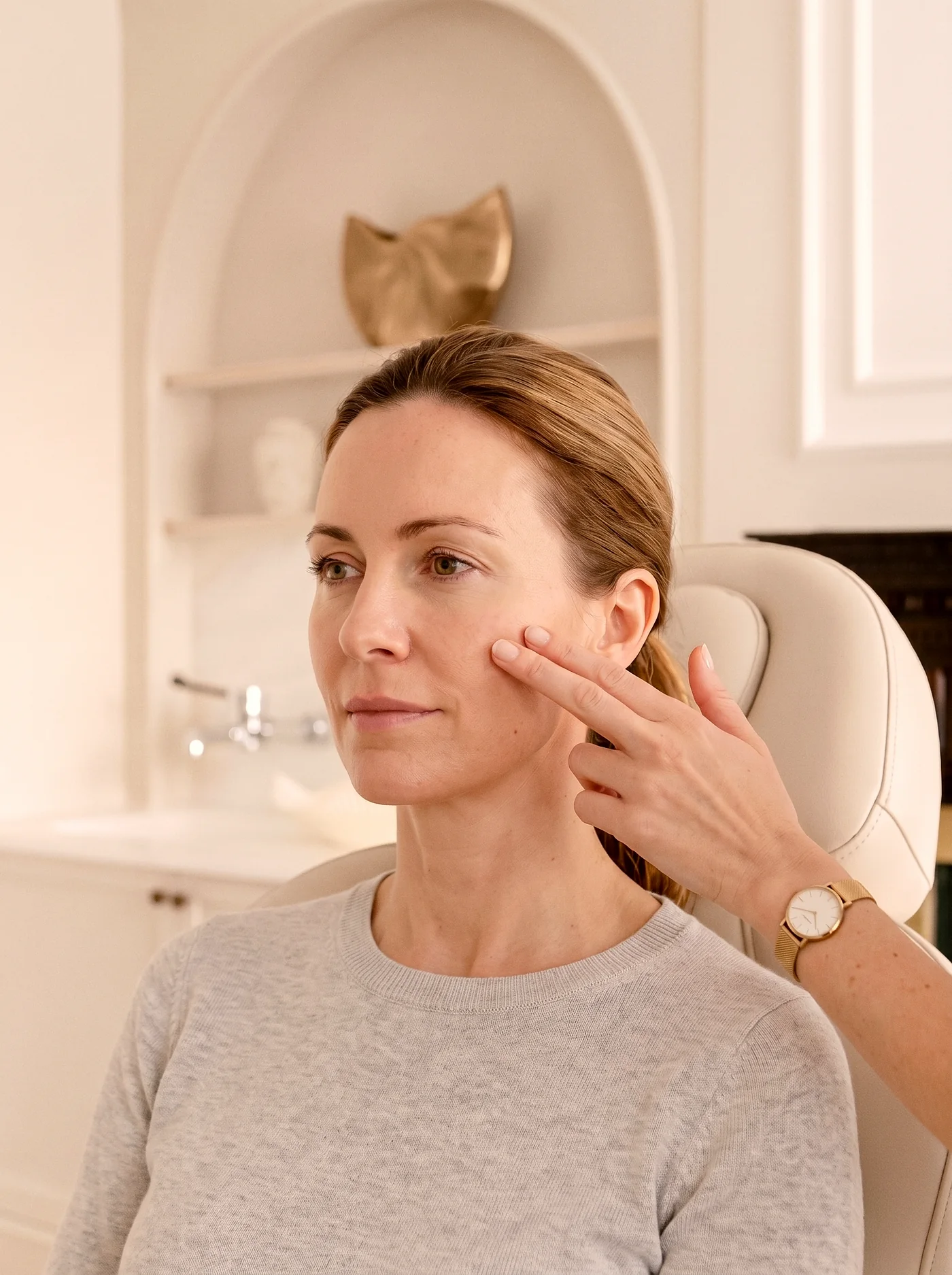
Why a skin booster is
injected, not applied
Hyaluronic acid is in plenty of serums, so it's fair to ask what an injection adds. The answer lies in where the hyaluronic acid ends up, and what it can do once it's there.
i
Where skincare stops
Creams and serums, including those made with hyaluronic acid, work on the surface layers of the skin: they help hydrate them while you keep applying them. That is worth doing daily, and it stops short of the dermis beneath, where a booster goes.
ii
What a booster places in the skin
A booster puts hyaluronic acid into the dermis itself, in small amounts spread evenly across the area, where it binds water. SkinVive and Restylane Vital are stabilised to break down slowly, so one treatment's effect is measured in months; NCTF is absorbed sooner, so it comes as a course. In the makers' studies, measured hydration improved with all three.
iii
What changes, and what doesn't
What can change is the skin itself: better hydrated, smoother to the touch, with fine lines less visible, gradually and for as long as the hyaluronic acid lasts. Your features stay just as they are, because a booster adds no volume and moves nothing.
What happens,
in order
Step 1 of 6 · Your first appointment
Your skin, read closely and planned for
Your skin's hydration, texture and fine lines are looked at closely, along with whatever else you'd like to improve; then you and your practitioner settle which booster suits it, where it goes and how many sessions it takes. You leave knowing the plan and what it costs.
Often confused
with skin boosters
Hyaluronic acid appears in more than one injectable, the word "booster" gets attached to products that do something else, and fine lines can be softened in more than one way. Here is what each of these changes, and how it can sit alongside a booster in one plan.
Profhilo
Profhilo is often described as a skin booster, and it is made of hyaluronic acid, but its maker designed it to improve facial and neck laxity, not only hydration, which is why we list it with the biostimulators. It is placed at a few set points on each side of the face and spreads out from them, where a booster is laid down in many tiny amounts through the skin. If your skin feels looser as well as drier, read about it there.
Polynucleotides
Polynucleotides also go into the skin, but their key ingredient is purified fish DNA, used for crepey, thinning skin rather than dehydration. Thin skin, particularly under the eyes, is their territory rather than a booster's. The two meet in the EyeLite Protocol, which pairs polynucleotides with NCTF beneath the eyes.
Dermal fillers
Filler and two of our boosters, SkinVive and Restylane Vital, are all stabilised hyaluronic acid gels, made to do opposite jobs. Filler is designed to hold its shape beneath the skin and replace lost volume or contour; a booster is designed to spread within the skin and leave your features as they are. Hollow cheeks or temples can call for filler; dehydrated skin over them calls for a booster.
Anti-wrinkle injections
Some fine lines are a movement change rather than a water one: they come and go with expression, around the eyes or across the forehead. For those, anti-wrinkle injections calm the muscles that make them; a booster leaves your expressions as they are and hydrates the skin itself. Where both are at work, one plan can hold the two, in an order your practitioner sets.
Your assessment tells dehydration apart from movement lines, thinning, loosening and lost volume, so each part of the change you've seen is matched to the right treatment, a booster included.
Where each drop goes decides the result
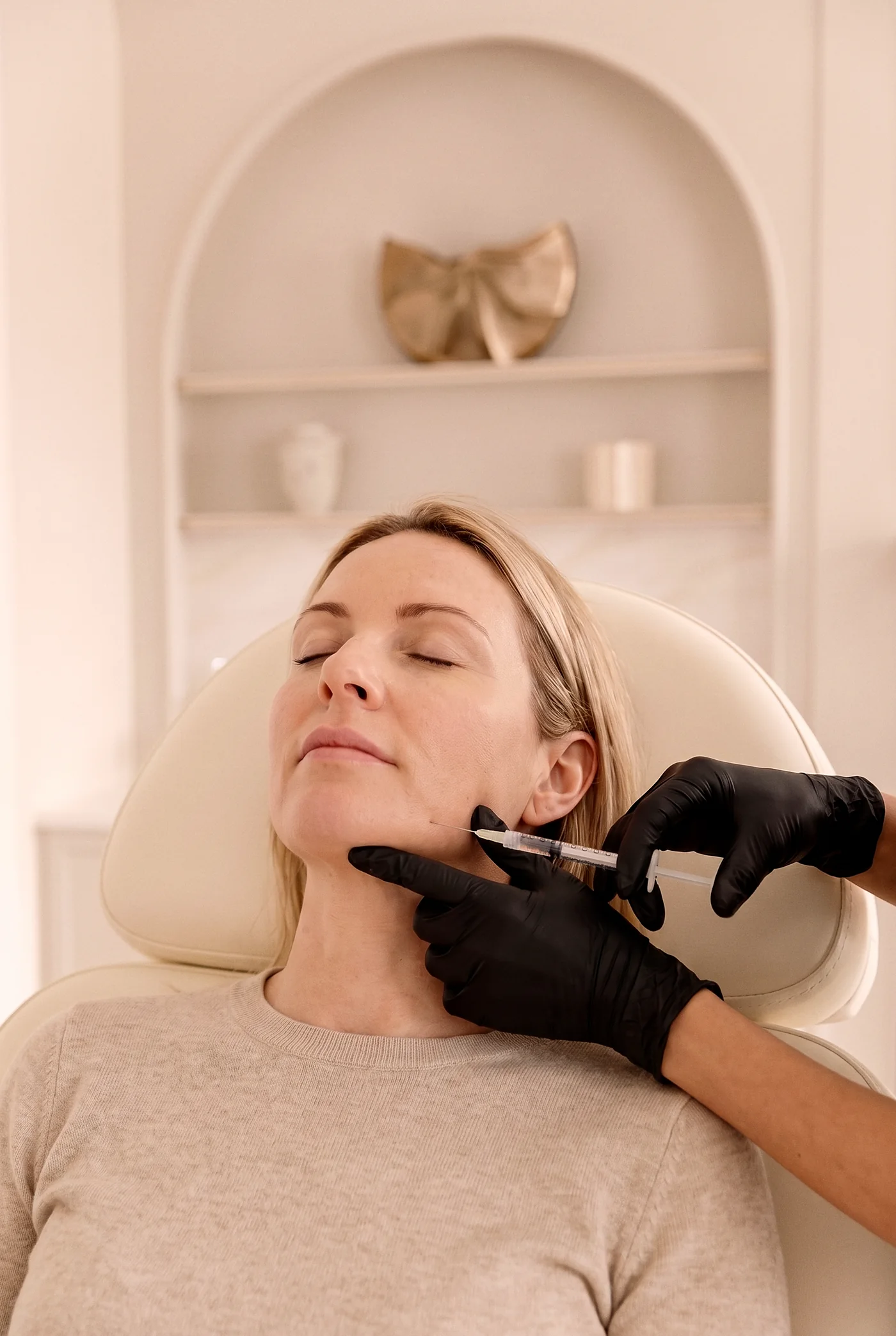
A booster is placed in the skin itself, not beneath it, and across a whole area rather than at a few points, so the result rests on dozens of small decisions made with the needle. In the expert guidance for SkinVive, each point takes between a hundredth and a twentieth of a millilitre, spaced half a centimetre to a centimetre apart. The depth is chosen for the thickness of the skin being treated, which differs between the cheek, the jawline and the neck, and getting it right, with a measured amount at each point, is what lets the bumps settle in a day or two.
Skin Boosters Pricing
Each fee is for one session. SkinVive and Restylane Vital cost the same and are priced by volume, one millilitre or two; Celora Vita and NCTF each have one fee per session. A consultation always comes before your first booster.
Dr Priya
Aesthetic Practitioner
SkinVive or Restylane Vital (1 ml), for the face or neck
£500
£450
SkinVive or Restylane Vital (2 ml), for the face or neck
£750
£650
Celora Vita, one session
£400
£350
NCTF, one session
£400
£350
Your consultation settles which rows apply: the booster your skin suits, whether the face, the neck or both are treated, how much product that takes, and who treats you. A course of three is charged session by session. The EyeLite Protocol, NCTF with polynucleotides under the eyes, is listed with the polynucleotide fees.
The complete schedule of feesBefore you decide
on a booster
Direct answers on comfort, the days after and how long the change lasts, with the makers' own figures quoted as they give them.
Does a skin booster injection hurt?
For most people it's a mild, brief sensation. The needle is very fine, SkinVive has a local anaesthetic mixed into the gel, and numbing cream is on offer for the other three. What you feel is a quick, light sting at each point across the area. A fear of needles is common and worth mentioning at the outset: you can ask for a pause at any point, and your practitioner will stop.
Will people be able to tell I've had a booster?
Not from your features, which a booster leaves untouched. What people may notice is skin that looks better hydrated and smoother. For the first day or so the small bumps show until they flatten, so leave a little room before an event.
Will a booster session keep me off work?
Rarely: in a published study of SkinVive, almost everyone was back to their usual social life by the next day. The small bumps and any redness settle within a day or two, which some people like to allow for before a meeting. Leave make-up off for about twelve hours, and for a period after each session avoid saunas, steam rooms, long spells in the sun and freezing cold.
Will I need one booster session or several?
That depends on the booster. SkinVive is designed to be given once, with a small top-up about a month later if your practitioner thinks an area needs it. Restylane Vital, Celora Vita and NCTF each take three sessions: Galderma suggests two to four weeks between Restylane Vital sessions, FILLMED three weeks for NCTF, and DermaFocus several weeks for Celora Vita.
How long will my skin stay hydrated?
Roughly six to twelve months, depending on the booster and on which result you mean. Allergan measured the extra hydration from one SkinVive treatment for up to nine months, and reports a visibly smoother look for up to six and fewer visible fine lines for up to four. Galderma says Restylane Vital lasts up to 12 months after a course of three, while its own instructions report improvement lasting six months from the first session. For NCTF, FILLMED advises at least two courses a year to keep the effect going, and Celora Vita is renewed with a further course whenever you and your practitioner decide. In every case the change fades gradually, as the body breaks the hyaluronic acid down.
Can a booster be undone if I'm unhappy?
Since the effect develops slowly and then wears off by itself, there is rarely anything to undo; if something doesn't look right, tell us and we'll book you in to be seen. If a lump or an uneven patch persists, the hyaluronic acid in SkinVive, Restylane Vital and NCTF can be broken down with an injected enzyme. What you learn from a first session also shapes the next, down to the booster and the amount.
Do men have skin boosters too?
Yes, for the same reasons as anyone: skin that looks dehydrated, rough or finely lined on the cheeks or neck. Nothing about the contours of your face changes, so the aim is simply to look less tired, and a session fits into a working day.
Men's skin and treatment
SkinVive is the one I've read about. Can I ask for it?
Of course, and if you've had it before, let your practitioner know how you found it. SkinVive is the booster designed as a single treatment rather than a course. It is priced identically to Restylane Vital, so the choice between those two comes down to your skin, not the fee. Your practitioner will set out how all four compare for your skin, and the decision stays yours.
Can a skin booster be used under the eyes?
Yes, with NCTF. Its maker lists the eye area among its uses, so it is the booster in our EyeLite Protocol, given with polynucleotides and booked with them. SkinVive and Restylane Vital are used on the rest of the face and on the neck, the areas their makers name. Dark circles and hollows under the eyes often have other causes too, each with a treatment of its own.
Why eyes look tired, cause by cause
Do I still need skincare once I've had a booster?
Yes. A booster works in the dermis and your skincare on the surface, so each does a job the other can't. Keep cleansing, moisturising and wearing sun protection every day; a booster adds to that routine rather than replacing it.
Can I combine a booster with anti-wrinkle injections or laser?
Often, because they treat different things: anti-wrinkle injections soften lines made by movement, and a booster works on the skin's hydration and texture. Laser treatments and peels are not done in the same session as a booster, so the sequence and spacing are set for you at your assessment.
Who are skin boosters suitable for?
Anyone over 18 whose skin on the face or neck looks dehydrated, dull in texture or finely lined, while the face itself has kept its shape, whether this is your first booster or your fifth. The few reasons to wait are pregnancy and breastfeeding, and skin in the area that is inflamed or infected, with active acne or a cold sore, for instance, until it has healed. Everything else is checked in your consultation's health questions: allergies, local anaesthetic included, and a small number of conditions that are talked through with you if they apply. Bring a list of your medicines, including any bought over the counter; a prescribed medicine is only ever paused if the doctor who prescribed it agrees.
Are there side effects with a skin booster?
Mostly mild ones that fade within a few days: a little redness, swelling, tenderness or itching, the small bumps at each injection point, and sometimes a bruise, occasionally showing a day or so after treatment. Less often, a lump lingers or skin tone changes, and infections, allergic reactions and blocked blood vessels are rare; your practitioner explains them all before you sign a consent form, along with the signs to watch for and the number to ring.
Hydration, planned for your skin
A comprehensive diagnostic consultation: a thorough assessment leading to a truly bespoke treatment plan, created by you and your practitioner.
Bring along the products you use on your skin now, or the name of a booster you've had before: by the end of the appointment you'll have your plan, from the booster to how often you'd have it, fitted around your routine and your diary. You won't be sold to, and you won't be pushed.
Request a consultation Call 020 3355 2030 Your first consultation, explained