

MediLUX LED
LED light therapy shines selected colours of light onto the skin from the five-wavelength MediLUX panel: painless and needle-free, with no downtime, designed to help skin look and feel healthier.
Request a consultationAt a glance
Onset
4–6 weeks
The span of a MediLUX course run twice weekly: the trials gave eight sessions or more and measured the change once each course was complete.
Longevity
8–12 weeks
How long the LED trials followed skin after a course, about three months; occasional sessions keep a change going beyond that.
Downtime
None
MediLUX needs no recovery at all: at most, skin feels warm and looks a little pink for a short while, and your day carries on as planned.
Discomfort
0–1/10
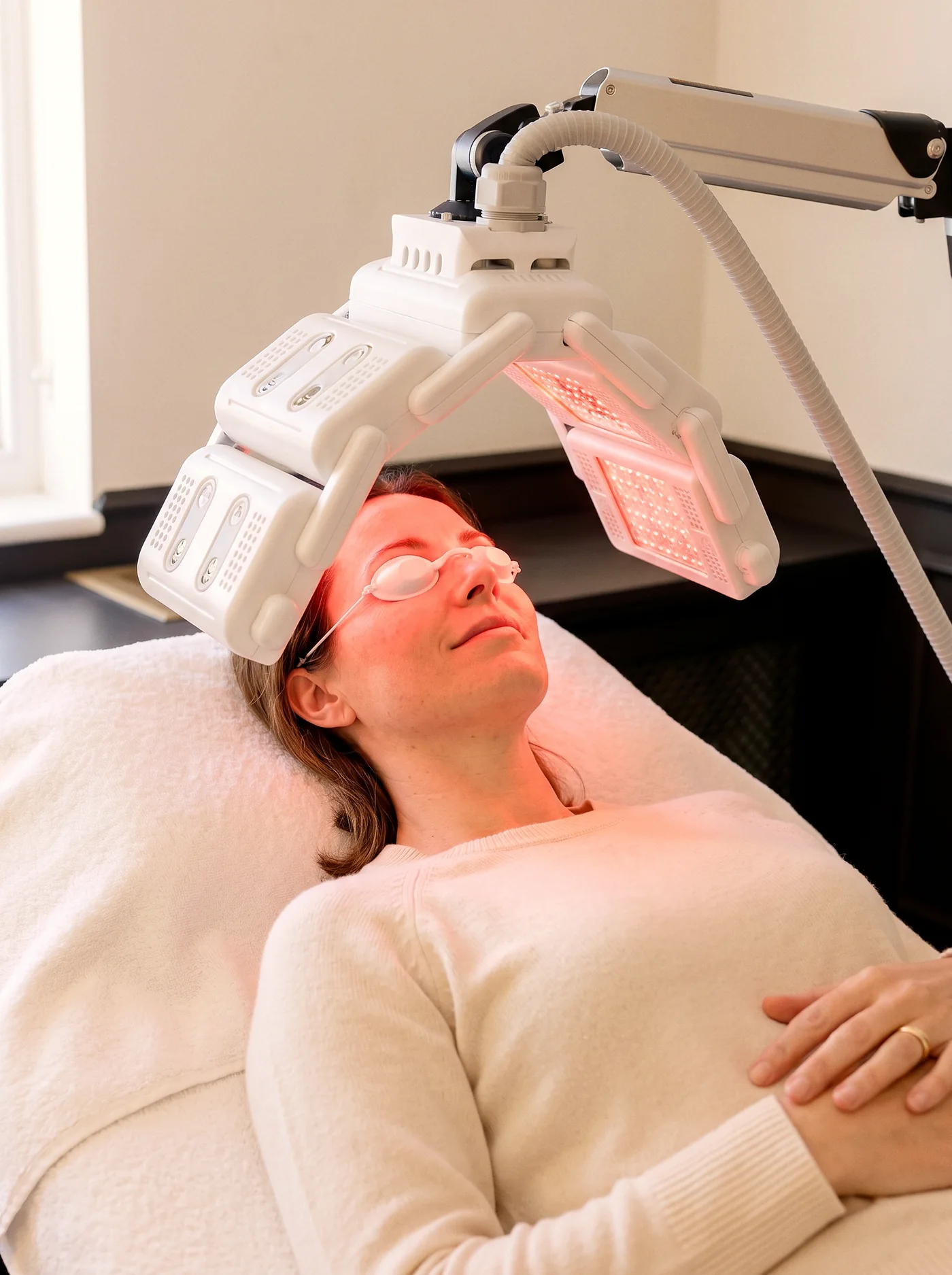
Nothing touches the skin: you lie back with goggles on, aware of bright light and perhaps a gentle warmth, and the panel is switched off at a word from you.
Procedure time
20–30 min
20 minutes under the light in MediLUX's pre-set programmes, and up to 30 with cleansing and goggles; within a facial, LED is one step of a 60- or 90-minute appointment.

Comfortable, needle-free, and set for your skin
LED offers something few skin treatments can: a session that stays comfortable throughout, with no needle, no more than a gentle warmth and nothing to recover from, using light chosen for your skin from five wavelengths. It is already part of three of our facials, and it suits anyone who wants to look after their skin without taking time out for it. People choose it for how their skin looks and feels from week to week, and it fits easily into a plan alongside treatment for pigmentation, scarring, laxity or lost fullness.
i
Light of one colour, and how far it reaches
i
Light of one colour, and how far it reaches
Each LED gives off light in a narrow band of colour, measured by its wavelength in nanometres (nm). MediLUX has five, from blue at the short end to near-infrared at the long end, and the longer the wavelength, the further the light travels into the skin before it is absorbed.
The principle behind the treatment, known as photobiomodulation, is that particular wavelengths are absorbed by skin cells and influence how they behave. It works through light rather than heat: unlike a laser, LED never warms the skin enough to need healing, so there is no recovery to plan around, and sessions can be repeated as often as your course needs.
ii
Questions about light sensitivity, then your skin examined
ii
Questions about light sensitivity, then your skin examined
Before a first session, your practitioner asks about your health, your medicines and supplements, and your eyes, since some of each can make skin or eyes more sensitive to light, then looks at the change you have in mind, so the settings can be chosen for it. The questions take only a few minutes, and your answers shape how the light is set for you.
iii
Settings and a course, chosen for your skin
iii
Settings and a course, chosen for your skin
Which wavelengths you have, alone or in sequence, and for how long, is decided by your skin and by what you'd like to change. So is the shape of the course: how many sessions, how far apart, and whether the light comes on its own or as part of a facial. You can stop at any point, and with nothing injected there is nothing to reverse.
iv
"Can light really change anything in the skin?"
iv
"Can light really change anything in the skin?"
It's a fair question, and there is a good answer. Light of the right wavelength does reach into the skin, and red and near-infrared, the two with the most research behind them, have been studied for the look of ageing skin, with encouraging results over a course of sessions.
LED is designed to work alongside the treatments that lift, fill or resurface, and that is how it is used here: already a step in three of our facials, and planned with other treatments where it suits your plan. It is the gentle, regular part of a plan, giving your skin steady care from one appointment to the next.
Blue to near-infrared,
one wavelength at a time
MediLUX has five settings, each a single colour of light that reaches a different depth in the skin. The research is strongest for red and near-infrared: studied on other LED devices for the look of ageing skin, with encouraging results.
Blue,
415 nm
The shortest wavelength of the five, blue light is absorbed nearest the skin's surface, and it can run in sequence with a deeper colour.
Green,
520 nm
A little deeper than blue, though still near the top of the skin, green light is used for the look of uneven skin tone.
Yellow,
590 nm
Deeper than green, though not as deep as red, yellow light has been studied for the look of sun-damaged skin.
Red,
633 nm
Red travels further into the skin than any colour you can see clearly, and is among the most studied of the five for the look of fine lines, smoothness and firmness.
Near-infrared,
830 nm
Just past the red end of what the eye can see, near-infrared reaches deepest of the five, and has been studied with red and on its own for the look of ageing skin.
How your settings are chosen
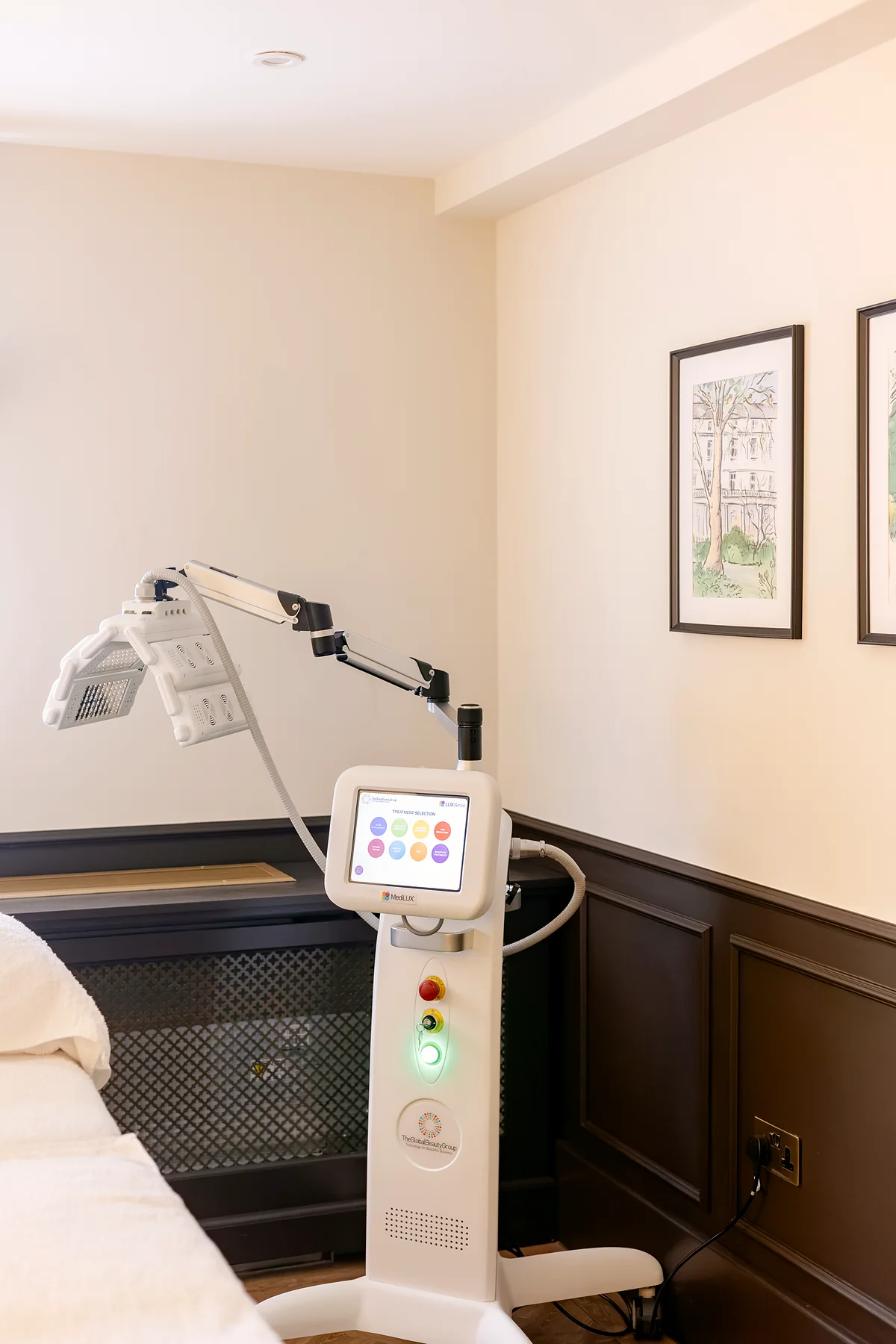
MediLUX runs pre-set programmes of 20 minutes and can also run several colours in sequence. Your practitioner chooses the programme from your assessment and adjusts it as your course goes on.
What happens,
in order
Step 1 of 6 · Ahead of session one
A few questions, then your MediLUX course planned
You're asked about your general health, medicines and supplements, any eye conditions, and whether bright or flashing light has ever troubled you; after a look at the change you'd like to make, you and your practitioner plan the course together: the colours, how many sessions and how far apart.
LED and the treatments
it works alongside
Each of these does something light doesn't, exfoliating the surface or working within the skin, so each is the stronger choice for a particular change, and each can sit in one plan with LED.
Facials, which add exfoliation to the light
If your concern sits on the surface, congestion, roughness or patchy tone, a facial will do more than light alone, because it exfoliates: an acid peel or an acid mask lifts away dead cells. Three of our four facials also include an LED step, so choosing one doesn't mean giving up the light. LED on its own suits someone who wants no acids and no flaking at all.
LaseMD Ultra, when the concern is pigment
LaseMD Ultra is a fractional laser that works in a grid of tiny zones within the skin's upper layers, and over a course it can improve pigmentation, sun spots, dullness and rough texture, with some redness while the skin recovers. LED treats no zones and leaves nothing to heal, which makes it the gentler of the two; where pigment is what you want to change, LaseMD Ultra is the one to choose.
Microneedling, for scarring and pitted texture
The SkinPen Precision Elite passes very fine needles over skin already numbed with cream, and the skin's response to those tiny channels, as the weeks and months pass, can soften the look of scars and even out texture, with a little recovery after each session. LED leaves the surface untouched and needs no numbing; for scarring, microneedling is the treatment to choose.
Skin Boosters, if dryness is the problem
When skin feels tight and looks dull for want of water, a skin booster works on that from inside: tiny amounts of water-holding hyaluronic acid injected across the area. There are four to choose from here, SkinVive, NCTF, Restylane Vital and Celora Vita, one of them matched to your skin. LED places nothing in the skin and involves no needle, so the choice comes down to the change you want and how you feel about injections.
Your consultation shows how LED and any of these fit together in one plan for your skin.
What a clinic adds to the light
Light is gentle, and a few questions first keep it that way. Some medicines and supplements, certain antibiotics and St John's Wort among them, and a few health conditions make skin more sensitive to light, so your practitioner asks about them at the outset and plans around your answers; your eyes stay behind goggles until the panel is switched off.
MediLUX LED Pricing
Today LED comes as part of three of our facials, at the facial's fee, and a price for MediLUX sessions on their own is given at your consultation.
Where LED is included
Fee
Signature Belgravia Facialwith LED from a choice of five colours (90 minutes)
£295
Fire and Ice Facialwith LED as one step (60 minutes)
£195
Obagi Blue Peel Radiancewith LED as one step (60 minutes)
£195
MediLUX LED sessions on their own
A facial's fee covers everything in the appointment, the light included. For LED on its own, your practitioner sets out the fee when you plan the course together.
Every fee, treatment by treatmentLED, from comfort to safety
The questions worth settling before your first session under the panel, from comfort and time to suitability and how long a change lasts.
Does LED light therapy hurt at all?
No. You may feel a gentle warmth on the skin and nothing more, and the goggles keep the brightness out of your eyes. If the light ever feels too bright or too warm, tell your practitioner and it can be switched off at once.
Would anyone guess I'd had LED?
Not from looking at you: at most your skin looks slightly pink for a short while, and there are no marks. A course works gradually, over weeks, so you may be the only one who notices a difference.
Does LED mean time off work?
No: a session leaves nothing to heal, so work can follow straight after.
How many LED sessions would I need?
Several sessions rather than one; the trials used eight or more, often two a week. Your practitioner plans the number with you and reviews it as you go.
Once a course ends, how long does the change last?
The trials followed skin for about three months after a course, which is where the guide of eight to twelve weeks comes from; how long yours holds also depends on age and sun. Your review sets how often an occasional session would keep it going.
What if LED isn't what I hoped for?
Your end-of-course review is there for exactly that conversation. If the change isn't what you wanted, you and your practitioner decide together what comes next, whether a different programme or another treatment for the change you came for. Nothing is injected and nothing removed, which leaves nothing to undo.
Is LED worth it for men?
It can be, for reasons that suit anyone short of time: no downtime, no marks and nothing to explain at work. Sessions are short and planned around your diary and the change you'd like to see.
Men's treatment, planned discreetly
Can LED treat acne or rosacea?
At ART Clinic, LED is chosen for the look and feel of the skin. If you have acne or rosacea, mention it when you come in, and your practitioner will plan your skin's care with it in mind.
Is a home LED mask the same thing?
A mask can use similar colours of light. What a clinic session adds is everything around the light: a device with known output, a practitioner setting the light for your skin, questions about anything that makes your skin sensitive to light, and a review of your skin's progress. If you already use a mask, mention it at your consultation.
Can LED be added to other treatments?
LED is designed to sit alongside other treatments, and it is already a step in three of our facials.
Is LED suitable for my skin and health?
For most people, yes: the light is gentle, and all it asks of you is to lie still beneath the panel. Three things mean holding off for a while: pregnancy, since LED hasn't been safety-tested for it, sunburnt skin, and skin that has had injections recently. Other things worth mentioning, from medicines that make skin more sensitive to light, isotretinoin among them, to eye conditions or light-triggered migraine or epilepsy, are covered by the questions before your first session, and your practitioner explains what each means for your plan.
Does LED light therapy carry risks?
Very few, all of them mild: a little warmth or pinkness that fades soon after a session and, rarely, a headache that passes. Goggles protect your eyes throughout, your practitioner explains it all before your first session, and if anything concerns you once you're home, just ring the clinic.
Ask a clinician about LED
A comprehensive diagnostic consultation: a thorough assessment leading to a truly bespoke treatment plan, created by you and your practitioner.
Come and find out what light could add to your plan: your practitioner will look at your skin, choose the settings that suit it, and show you where LED fits alongside anything else you're considering. You won't be sold to, and you won't be pushed.
Request a consultation Call 020 3355 2030 The appointment where the plan is made