Endolift® candidacy: what to know
Asking whether you are a candidate for Endolift® is really asking whether it will do what you hope for your face or body. The answer comes from looking closely at what has loosened, how the skin behaves and where you are in your life, and you can understand every one of them before you ever sit in the consultation chair.
By Dr Priya Verma, who trains the Endolift® doctors at ART Clinic · October 2026

What "candidate" should mean
The word has a slightly clinical chill to it, as if there were an exam to sit. I prefer to think of it as a fit. Endolift® does a particular thing to a particular kind of tissue, and the more closely your own change resembles that, the more clearly you will see the difference.
So the useful questions are practical ones. What exactly has loosened, and how far? How does your skin respond when it is lifted and let go? Is there fat or lost volume mixed in with the looseness? And is now a good moment in your life to plan it? None of these needs you to arrive with an answer; that is what the assessment is for.
The change Endolift® is designed for
Endolift® is designed for skin that has begun to slacken, from the first signs through to a clearly settled jowl. A hair-thin laser fibre slips under the skin through one tiny opening and warms the loosened layer from within. That warmth draws the tissue in a little on the day and, over the months after, sets off the collagen-building that does most of the firming.
On the face and neck, that usually means a jawline that has lost its edge, jowls, fullness beneath the chin, or a neck that has softened. Because the fibre sits in the same layer as the small pockets of fat along the jowl and under the chin, it can also reduce some of that fullness in the same appointment.
On the body, Endolift® is offered at ART Clinic for loosened skin alone: the inner upper arms, the abdomen, the inner thighs and the skin above the knees, most often after weight change, pregnancy or simply the passing years.
What it keeps is as important as what it changes. Your features, your expressions and the proportions of your face are left alone, so the result reads as firmness rather than alteration.
What the assessment looks at
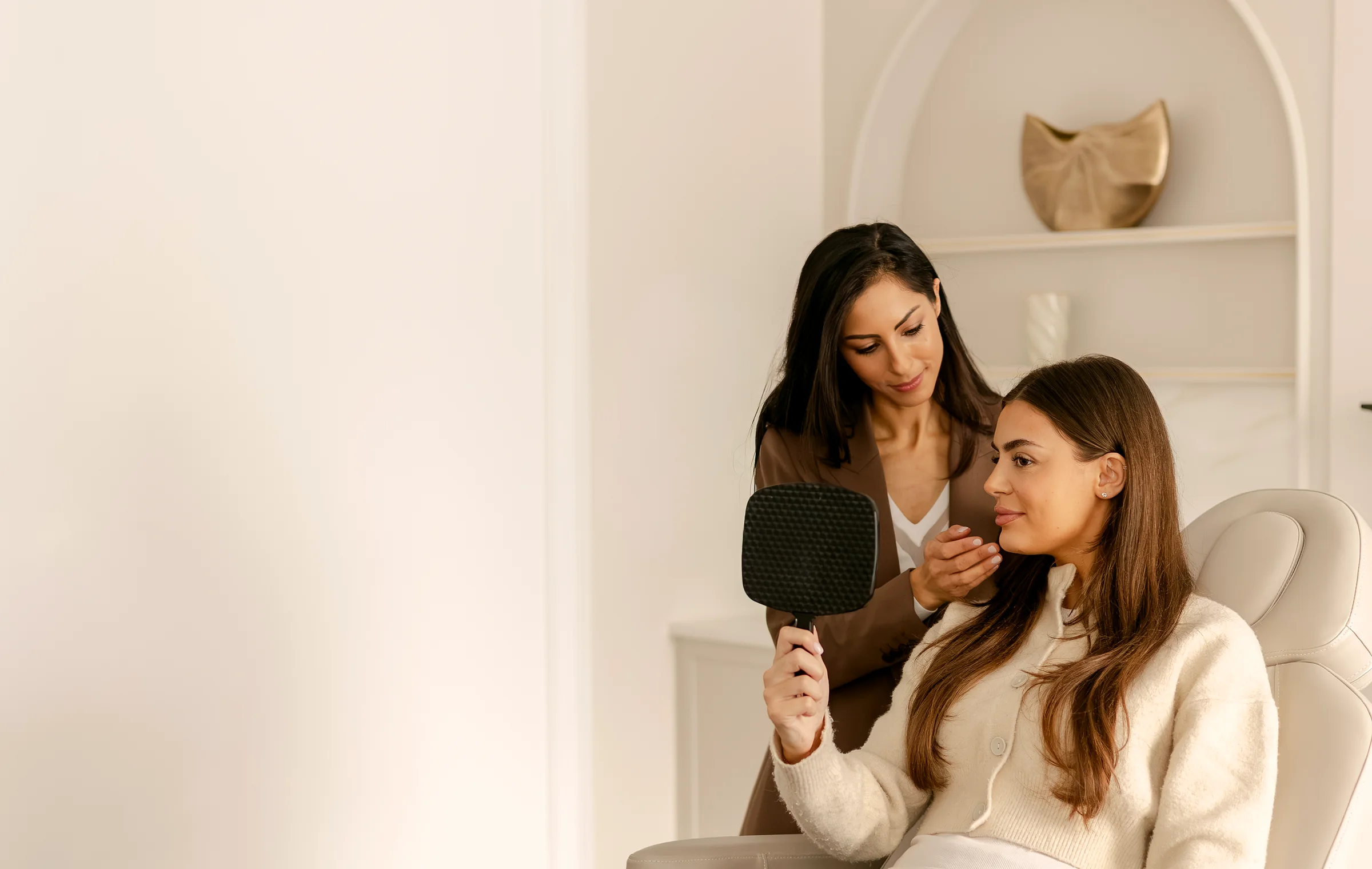
When one of our doctors assesses you for Endolift®, the examination follows the same order whether you have come about your jaw or your arms. Here is what we look at, and what each finding changes in the plan.
How far the loosening has gone
We look at the area at rest, then as you talk, turn and tilt your head, or, on the body, as you stand, sit and raise your arms. Early loosening and a more settled slackening both respond; knowing which you have tells us how visible a change to expect, and which other treatment, if you would like one, could play a part in the plan.
How the skin springs back
A gentle pinch and release shows how much elasticity the skin still has, and how thick it is. Skin with some spring left tends to respond well to tightening from beneath. Where the skin is also thin or finely creased, a treatment for its quality is often planned beside Endolift®, so that the surface keeps pace with the firmer layer under it.
Where fat and volume sit
Heaviness along the jaw can come from loose skin, from a small pad of fat, or from support that has thinned beneath, and usually from a mix. Each part is answered differently, so we separate them before anything is planned.
What has been done before
Filler, threads or earlier energy treatments in the area are all worth mentioning, including ones from years ago, and it helps to bring the product name if you have it. Knowing about them helps us plan: they change how the fibre is guided, and sometimes when the treatment is best timed.
What you would like to see
Some people want a sharper jaw for photographs, others want their neck to stop bothering them in the mirror. Knowing what matters most to you decides which areas are treated first, and how we judge the result together at your review.
Five starting points
These are the presentations I see most often when someone asks about Endolift®. Most readers will recognise themselves in one, or in two at once.
i · A jawline beginning to soften
What tends to suit:
where the edge of the jaw has only just started to blur, Endolift® and XERF are both good places to start, and ART Clinic offers both. XERF works from the surface in one needle-free session; Endolift® works from beneath, and is usually a single appointment as well.
What may join it:
a skin booster, if the skin has also grown dry and dull.
ii · Jowls and fullness under the chin
What tends to suit:
this is the change Endolift® Face answers most directly, because it can firm the slack tissue and reduce a little of the fat that sits with it, in one visit.
What may join it:
a little filler along the jaw or at the chin, where missing support makes the jowl look heavier than it is.
iii · Loosening in skin that has also thinned
What tends to suit:
Endolift® for the looseness, with the skin's quality treated in its own right.
What may join it:
a biostimulator such as Profhilo, or polynucleotides, spaced around the Endolift® appointment so each has room to work.
iv · Loosening beside flattened cheeks or temples
What tends to suit:
firming for the loosened layer and structure for the flattened one, planned as a single sequence.
What may join it:
dermal filler at the cheek or temple, or a collagen-prompting biostimulator where support is better rebuilt gradually.
v · Body skin loosened by weight change or pregnancy
What tends to suit:
Endolift® Body on the arms, abdomen, inner thighs or knees, area by area, once your weight has held steady for a while and, after a pregnancy, once you feel fully recovered.
What may join it:
polynucleotides where body skin has become papery, or LPG Endermologie as ongoing care for its texture.
Whichever row is closest to yours, the plan that comes out of your assessment is written for your face or body alone.
When timing matters more than the face
A few things in a medical history shape when Endolift® is best planned. If you are pregnant or breastfeeding, we plan it for afterwards. If you take a medicine that thins the blood, or one that affects how you heal, we talk it through with you and time the treatment around it. Filler recently placed in the area is given time to settle first, and a patch of irritated or broken skin is simply allowed to heal.
Life has its own calendar too. Swelling is the part of recovery to plan around, so a date with an important event close behind it is better moved a little. For body areas that show in summer, many people choose the cooler months. And if you are travelling to London for treatment, the consultation can map the days either side before you book a flight.
What else might be planned
Loosening seldom arrives on its own, and Endolift® is often one part of a plan rather than all of it. The way I think about it is by layer: Endolift® takes the laxity, and other treatments take what lies above or beneath it.
For the surface of the skin, skin boosters restore hydration and smoothness, and polynucleotides help skin that has turned thin or crepey. For support within the tissue, the biostimulators work over a course to encourage fresh collagen, so the change builds gradually. For structure that has gone, dermal filler rebuilds it where it is needed. And for early loosening in someone who would rather avoid needles, XERF offers a surface-first route with no needles at all. On the body, LPG Endermologie and polynucleotides are the treatments most often planned alongside.
The order is part of the plan. Collagen takes months to build, so treatments that depend on it tend to begin early, and anything placed in the same layer is spaced so that each can be judged on its own.
If you have already decided, or had it before
Many people come to us having read about Endolift® for months and knowing it is what they want. That is a fine place to begin. The assessment then shapes how it is done: which areas, in what order, and what may sit beside it.
If you have had Endolift® before, at ART Clinic or at another clinic, bring what you know about it: the areas treated, roughly when, and how you felt about the result. Your doctor looks at how the tissue has held and plans the next step from there.
At ART Clinic, Endolift® Face is performed by me and by Dr Michelle Emett, whom I trained in the technique, with the same assessment and aftercare whichever of us treats you.
Further reading
Endolift®
Concerns
Find out where you start
Your consultation begins with the change you have noticed and ends with a plan that names the areas, the timing and anything that might sit beside Endolift®, with the fee set out before you choose a date. You won't be sold to, and you won't be pushed.